Tuesday, April 3, 2012

Building Chapels, Building Self-Reliance

In the DR Congo, the two missions realize approximately 500 convert baptisms per month. That amounts to almost a ward a month. The retention and activity rate remain high. The Congolese people are very spiritual, open, and love the Lord. They have very few books to read, however most have a Bible. They read the Bible, are conversant with the scriptures, and easily accept the Gospel of Jesus Christ. They live in great poverty and difficulties. Unemployment, disease, and poverty. However, one of the favorite hymns that they sing whenever hymns are sung is, "Count Your Many Blessings." A joy comes into their lives with the Gospel. Temporally, it remains difficult, but the hope, faith, and promise of eternity fills their hearts. A dual problem arises with high growth rates and unemployment. 1. What do we use for meeting houses if we convert a ward a month? I recently saw retention figures showing 95% retention over the past 13 month period. Many wards have 110% attendance at sacrament meetings - high activity rates and many non-member visitors. 2. How to we help provide opportunity for members to gain the requisite skills to find work. This question has pre-occupied the thinking of the Church, as the member population grows rapidly in developing countries. BUILDING CONCEPT
Last year, the Church announced the intention to create a pilot program in the DR Congo. If the Church could facilitate training of members in the building skills, members could find employment or create jobs for themselves. The First Presidency approved a plan to build more modest chapels using the membership to do so. As a young missionary in France, I briefly participated in the volunteer or missionary building efforts then in place. As I finished my mission, my mission president asked if I and a few others would extend our missions for a month or two to help with the construction of a chapel in Nice, France. There, French, Swiss, and Belgian young men were called as labor missionaries to construct the new chapel. It was a wonderful program, these young men learned skills and trades as well as providing a great service. This program was discontinued in the mid 1960's. Revisiting the concept, the Presiding Bishopric, under the direction of the First Presidency, put a new plan in place. A program to train worthy individuals (focusing mostly on return missionaries) in the building trades, then hiring some of them to construct chapels. Suzanne and I were fortunate enough to be in a small meeting with Bishop Burton, the Presiding Bishop of the Church, as details were set in place. Because the Perpetual Education Fund should play a role in the education process, we were invited.
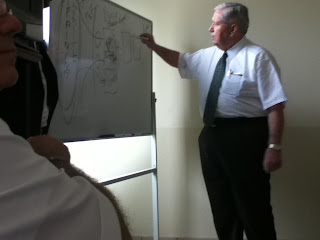
There, Bishop Burton made it very clear that "this is a training program, not an employment, or building program." And, that "Return missionaries are the prime target for this effort." A native French Brother was assigned to direct the effort. He is from Salt Lake and has been involved in building and has spent much time in Africa directing temporal affairs of the Church. Also, an extremely talented and spiritual brother from France was assigned to lead the projects here in Africa. In 6 months time, the plans were completed, working with LDS Business College in Salt Lake City, instruction manuals, "how to" videos, and curriculum were developed. And the program initiated. About this time a brother retired from a Salt Lake City college where he had taught construction techniques for 30 years. He and his wife decided to serve a mission. He mentioned to his sister that he would love to serve a mission teaching building principle in an emerging nation to help return missionaries become equipped with skills that would help them become employed and self-reliant. His sister happened to work at Church headquarters and mentioned to Bishop Burton about her brother's desire. To which Bishop Burton replied, "you just answered my prayers, where is he?" Elder and Sister Billings arrived in the DR Congo - Kinshasa Mission three weeks ago. They are truly an answer to prayer.
Here is a typical class at work with Elder and Sister Billings. preparing the site, laying a foundation, and basic masonry. The young man in the green shirt in front is one of our PEF students and former volunteer at the PEF Service Center. Elder and Sister do not speak French, and this young man was hired as their interpreter. We hated to lose him, but are pleased that he found employment and can be of great service while the Billings learn to speak French. (For the Huntsman family, he served with Johnny in South Africa.)
Yesterday, Elder Billings was teaching them to make a "saw horse" in order to learn basic measuring and planning skills. The interpreter had no idea what a saw horse was. It took quite a bit of explaining to get that point across. It was perhaps the first saw horse in the DR Congo. By the way, the name for a saw horse is "trétaux."
There are very few power tools in the DR Congo. Most of the work is done by hand saws, hammer and nails, etc. These pictures were taken at the training site behind the Kinshasa Stake Center. The Seminary and Institute Building which houses the Seminary and Institute facility, the Center for Young Adults, and the PEF Service Center are adjacent. They hold classroom theory in the class-room next our our office in the morning, then practical application on the practice area outside.
Elder Billings on the training site doing the two things he loves best - teaching young people how to build properly - and serving the Lord as a missionary.
Sister Billings using a desk in our office to keep up with the administrative and keeping a journal of the progress. There are currently two chapels being built by previously trained teams of return missionaries in the Kinshasa area. 20 more chapels are in the planning stage to meet the growing needs in throughout the DR Congo. One does not have to look very far to see the hand of the Lord in the work in Africa.

Sunday, March 4, 2012

Eustache Ilunga, is the Director of the Employment Resource Center for the Church in DR Congo. He is one of our very good friends, and also our Stake President. He is very forward thinking and always looking for ways to help people become employed and self-reliant. A year and a half ago, in working with one of the local stakes, he and that stake president approached a local micro-bank about how they might make micro-loans to members who had small businesses. Now, a small business in the DR Congo consists of selling goods or services along the roadside.
These are typical street scenes with people selling from baskets on their heads and small "boutiques" of people sitting on the side of the road selling things. The buildings in the background are real stores. Now, over a year and a half ago, these twenty people have received loans and paid them back with interest and most of their businesses are doing well. A few month ago, due largely to the success of the this micro-loan experiment, the Church sent people over from Salt Lake to expand a pilot program that is being used in South America. The two originators of the concept, were two guys who had done well in business and retired early. They were bored and collaborated on a program for the Church to teach business principles centered on self-reliance. We were invited to attend the initial training program. It was really well done and generated a good deal of enthusiasm among the pilot group.
Photo of the initial training of priesthood leaders for the project. Priesthood leaders and mentors were selected to teach and mentor each of the groups. Each team had a mentor who taught them, using the prepared materials. The program model is to find success in three basic areas. Their business, their home, and their community. By enlarging the model to include the family and the community, the effort does more than business, it improves their families and the community becomes better because the business people look outward. Creating cleaner, safer, and more friendly neighborhoods. The materials are really well done and allow mentors and leaders to quickly become good teachers. Two stakes were chosen to pilot the program - Ngalema and Kimbanseke. The model used was that which has been successful with the global micro loan experience. Groups/teams of five were established. Each member of the team had a different business, but they learned and worked in concert. They formed, in effect, support groups. Each group meeting weekly to encourage and hold accountable the other members of the group. At the same time, the employment resource center (ERC) continued to teach and mentor. Saturday, we were invited to the graduation ceremony for the Ngalema stake. About 30 people received certificates of graduation. Two sisters bore testimony of how the training, the program, and their team members had increased their success in the three areas of emphasis - their business, their home, and their community.
A group of sisters who graduated from the program. The Ngalema stake president spoke and reminded the participants that the diploma was only the start, that they should continue in their efforts. Also, three mciro-banks were invited. The one that made the initial loans to the 25 people from masina reported that these twenty five were the model of excellence. They had faithfully repaid the loans and had were continuing to improve their businesses. He stated that his bank would encourage other members of the the Church to visit his bank. The two other banks that were invited seemed very eager to have this new group as customers.
most of the participants were women. This seems consistent with what I have read concerning micro banking and third world entrepreneurs. Leslie Tunks turned us onto a great book Banker to the Poor by Mohammad Yunus. The woman pictured above has started smoking fish and selling them along side the road, another took advantage of the Church's Relief Society sewing classes, and makes clothing. As you will note all of the women had on beautiful Congolese dresses. One couple has a "play station location where they rent computer and play station to kids. Another sold bread, one made small cakes and sold them.
The Play Station Couple
These kinds of programs are sorely needed in the DR Congo. The graduates were singing and dancing and very proud of themselves. They had accomplished a good thing. They were fighting poverty at its very core, unemployment. We are glad to belong to a Church that does so much for its people.

Sunday, February 12, 2012

An Incredible Woman

Note: actual location and names are not used in this blog due to caution against child trafficking. STOP CHILD TRAFFICKING There are many people who do tremendously heroic things here in the DR Congo. On of them is a woman who runs an orphanage. She has no funding, no support, and no real means to support herself and the 20 or so orphans she cares for. She is a member of the Church who saw the need and responded to it. She lives in a remote village from the center of town. She has been caring for orphans for 15 years. We came to know of her through one of our friends. At Christmas-time, we received a package from our kids containing many wonderful items that we could not get in the DRC. Emily sent over 24 pair of children's underwear (slips, in French). We finally had an opportunity to deliver them to her this weekend. We went with the Hatches and a Congolese friend to visit her. Between us, We made peanut butter sandwiches and cookies, bought bananas,a 50lb bag of rice, a ream of paper, pencils, a ball, and some other little things.
Getting there was not an easy car ride. When we arrived we met a wonderful courageous women. She had very little. The physical facilities were very meager. In the yard was a large hole - surrounded by bamboo poles warning you to stay away. It was their cesspool and garbage pit. When it got full, they dug another one. Also in the yard were three sewing machines (treadle type as she has no electricity). She told us that the tarp/tent covering the sewing area had recently been torn off during a strong rain/wind storm. We learned that she taught sewing lessons to the women of her neighborhood. If a person can sew, they can earn a living. She teaches the classes for free, then for ten dollars per month a person can use the sewing machine to make clothing, etc. and earn a living. There are 30 women in the neighborhood who are in her program. She uses the money from the use of the machines to defray costs of the orphanage.
Suzanne gave her the ream of paper, and the woman almost wept. She said that she had not had paper for her little school for some time. Oh yea, she also runs a school for the orphanage children, and any other neighborhood children willing to come. There is a man who is crippled, and has some education, who comes and teaches the children. He teaches the basics of math, reading, and French. In the villages most people speak Lingala. Many poor village children do not speak French, which becomes a disadvantage when they leave the village to work or study in the city. Here all of the children speak French because the great man has taught them French. The school room is a 10X10 room with about 20 children of varying ages.
The woman named the orphanage after her father. She said that in her time as a young woman, girls did not go to school. Her father determined that his girls would receive education. I asked her if others in the village gave her father a bad time about this. She said that he had been criticized by the other men in the village. Women were to marry, not become educated. He told them that his girls would be educated. Now, she is educating more girls and boys a generation later.
The children sleep on mats on the concrete floor. One little room for the boys, and another for the girls. Food is cooked outside on a charcoal stove. A woman was washing children's clothing in a bucket, the water for which she had brought out of the steam that runs near by and heated over the charcoal stove. The water was, of course, polluted in the stream - fortunately she boiled it first. The kids have the clothes on their backs and maybe a few other pieces of clothing they all share. But, no one look unhappy, underfed, or unloved. The kids loved the ball and started a soccer game right away. Of course, the old white guy kicked it into the cesspool hole on the first kick. But, undaunted one of the kids jumped into the pit, retrieved the ball and the game went on. She was very grateful for the sandwiches, bananas, and cookies. Especially, she was happy to get the rice. She told the Hatches that when they had sent out a bag of rice and beans a couple of months ago, that they were running out of food and she was praying for help - and here came 100 lbs of rice and beans. Tender mercies. We met a remarkable young boy there, a 13 year old Teacher's Quorum President in his ward, who has been in the orphanage since he was 1 year old. He assists now with others and is a role model for the children. He told us he is preparing to go on a mission when is turns 19. He had attended the youth conference we showed in an earlier blog, and had received a copy of the Book of Mormon. We will give him a Bible next time we see him. And, a white shirt and tie. Elder Hatch, will leave pants, belts, and ties for him - as they are done and going home next week. This boy will raise children who will become a great generation of responsible citizens. We would like to be here when he returns from his mission and assist him to obtain a PEF loan and attend college. By the way, the underwear was a great hit. Most of the orphans were in class along with many of the neighborhood kids. We only had enough underwear for the orphans, so the woman will give them to them later. But a couple of the young ones were happy as they could be with real underwear.
Among the poverty, filth, and tough conditions we found an incredible women who had decided to help others and make people around her better. Women sewing as an alternative to prostitution or worse. Children leaning basic education skills. A small community and perhaps a nation becoming better because of her. We realize that we have so much, and she so little. Yet, she does more that we do to improve the lot of others. We think that others with more could contribute to this woman's effort to serve. If we do, it will make her life and effort easier. If we don't, we don't, and she will continue to do what she does with grace and love and gratitude to her Heavenly Father for her blessings. We have been privileged to meet a great woman.

Monday, January 16, 2012

Yes, this is the third blog today... It is a holiday here - Martyr Day - and we are home, so I am catching up. Saturday, we were invited to attend a grand opening for a Humanitarian Project. This one was one we had visited earlier in its formation stages. The project consisted of 7 clean water wells, a bathroom and wash area at a school, and a rain water capture project to provide water for the bathrooms and washing area at the school.
I snapped some pictures out of the side window of the moving car. They are scenes along the way to the project.
SORRY, SOME ARE BLURRY BECAUSE THE ROAD WAS ALMOST NON-EXISTENT AND WE BUMPED ALONG A LOT. This project is located outside of Kinshasa in a village area. To get there we went with the mission president in his four-wheel drive rig. We all drive four-wheel drive pick-ups or wagons. The road to this site is made for a four-wheel adventure. Many of you would like to spend your week-ends four-wheeling in this area. The trails we followed were narrow, sand-filled paths and trails mostly. At one spot, you must slide the tires along an old pipe that may have once been used for water, then drop down a steep run into a big hole. That when it rains is a small lake. Eventually, you end up at the site. We of course were the only car there. The Stake President arrived after us, he may have hitched a ride on one of the many motor cycles used as taxis. They typically load the driver and up to three passengers onto the cycle.
THE BLUE CHAIRS AWAIT. The man in the suit is the director of the NGO (non-governmental organization) who managed the project. His organization was contracted by the Church to do the construction work. The name of his organization is Congo-Kazi.
We arrived and were greeted by hundreds of children. They were dressed in their school best - white shirts and blue skirts/pants/shorts. They had been waiting along the road for us. They sang on our way in and were excited when we got out of the car and would shake their hands. I am sure that it is the first time many of them had seen a "mondele" (white person) up close and personal.
This is the first part of the project. Two tanks to catch rain water and run the water into the latrine and hand washing station. There is also a run-off pipe that when the tanks are full, the village can get water here from the flow. The children sang a song about how they can now wash their hands before eating, and after using the bathroom and therefore prevent disease. We don't think about disease much at home, but here typhoid, cholera, and any number of amoeba are a constant threat. Bad water also attracts mosquitoes which bring malaria, yellow fever, dinge fever, etc. This year in the DRC thousands of children died in the worst cholera epidemic in 50 years. The two most deadly animals in Africa are Rhinos and mosquitoes.
The rain is captured in these "gutters" and runs into the tanks. School is generally in session during the rainy season, so there will be sufficient water for the school year.
The second piece of the project is this bathroom. Written over the door it says "A gift from the Church of Jesus Christ of Latter-day Saints." The Village Chief did the ceremonial cutting of the ribbon. I was concerned that I might be asked to take the ceremonial first "leak" in the new toilet, but fortunately, they skipped that part.
The village chief is a very important person. He is elected by the village to be their leader. He was very happy about the project. The village area chief of police and the senior military officer were also there.
The entire school turned out for the ceremony. The children sang and danced and thanked us.
As usual, all the Mondeles and dignitaries had front row blue plastic chairs.
We then went to one of the well sites and had the ceremonial cutting of the ribbon and drinking the ceremonial first glass of clean water.
Sister Bingham drinking the clean water. The Binghams are the Humanitarian Service Couple who have accomplished all of this amazing work. If one visits the simple grave sight of Robert F. Kennedy, in Arlington Nation Cemetery, these words are on the wall next to his grave site. Spoken in South Africa in 1966 "It is from numberless diverse acts of courage and belief that human history is shaped. Each time a man stands up for an ideal, or acts to improve the lot of others, or strikes out against injustice, he sends forth a tiny ripple of hope. And, crossing each other from a million different centers of energy and daring, those ripples build a current that can sweep down the mightiest wall of oppression and resistance."
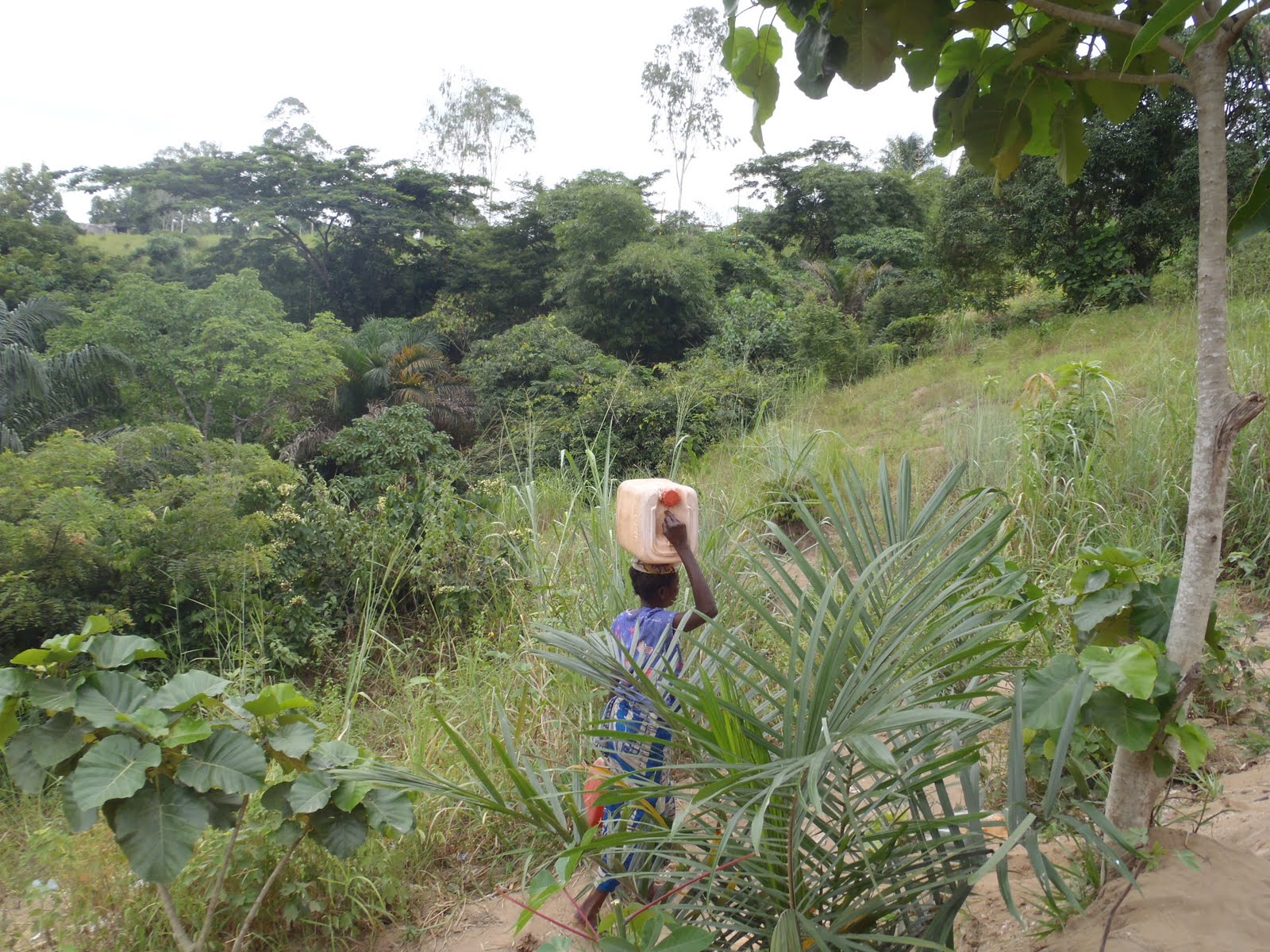
A village women climbs the hill with containers for clean water on her head.

Here comes the bride, here comes the judge

Friday, we were invited to attend the civil marriage of two of our PEF students. We have mentioned Pepithio before. He is a great young man. He is the "model" for the PEF applicants and students. He is going to school to become a software engineer. He also works at the American Embassy on their "help desk." His fiancee is a beautiful young women who is also a PEF student. We felt fortunate to be invited as it was pretty much family only. This is one of three ceremonies they will have. The law requires that they be married by a judge civilly before they can go to the Temple to be married. So the sequence for them is 1) the civil marriage by a judge, 2) The traditional marriage which will include a ceremony by their bishop and an all night party, and 3) in February the will go to Johannesburg to be sealed in the Temple. They explained that we are invited to the traditional ceremony, but since it starts at 8 pm and goes till sunup, and is in a rougher part of town, we would not be safe in attending. So, we settled for the civil marriage.
THE HAPPY COUPLE IN FRONT OF THE CONGOLESE FLAG As we arrived, the families recognized us (the only white people within 20 miles) and, as they always do, made us feel very much at home. Now, there are a couple of things to discuss before continuing the story. 1. Wherever we go as invited guests in the Congo, we are treated like royalty. We are always given places of honor and watched after. It is a very special gift of the Congolese people. Sometimes we are a little embarrassed by their kindness, but it would be impolite to refuse. So, the father of the bride took us under his wing for the ceremony. 2. To find you a place to sit and something to sit on is very important to them. The common seat is the "blue plastic chair." See the next blog for an array of blue plastic chairs. 3. The room in which the marriage took place would have a sign on it in the U.S. that said "maximum occupancy 50 persons." But no such sign exists here. So the room for 50 was occupied by about 200 with people outside looking in through the barred windows. 4. The city hall (an overstatement) is also the local jail. So it can become interesting. 5. Nothing in the Congo is ever on time. One can expect up to a two hour wait for people to arrive and the occasion to start. This was no exception So, on with the story. The father of the bride, rounded up a couple of blue chairs for us, went to the person guarding the door into the marriage room and had a word with him, then returned, took the two blue chairs and set us in the very front of the room next to the judges table. It was a very sunny hot day. Inside the room it was like 2000 degrees. As we sat there, couple dressed in their marrying best started to arrive. About a dozen of them. We learned from our host that our wedding couple was en-route in a public transport, and did not know how soon they would arrive. (Had we thought about it, we would have asked if we could pick the bride and groom up and bring them in an air conditioned car and not in the non-air conditioned really awful transport). But, they finally arrived - before the judge who was to conduct the ceremony arrived. https://blogger.googleusercontent.com/img/b/R29vZ2xl/AVvXsEjtEIwAT31wBy-yfT212qbJxJ6ycgw8Z0dCB6XlEK88RXhGqsBnmsHp0pT9LAfGAidL4E6_7uhpYZdXl0_p3g60xwbDMKHL-rvRbNFVjlm3WmkC6FBABWvb9_cSINGf_4UhU2LufrbKHRRh/s320/wedding+pepithio+112.JPG" />
Unfortunately, the window light and the bright sunlight does not bode well for taking these pictures. But, the judge was a little man wearing a white uniform with the blue, red, and yellow sash of the Congolese government.
The judge was very friendly, and liked having his picture taken. Before he performed the ceremony, he pontificated on marriage for about 1/2 hour.
Other brides and grooms.
Crowds and chaos marked the day.
City hall from the outside. People waiting for their loved ones to come out. Even though the room could have crowded more people into it, if you had a crowbar, many remained outside, the "bouncer" closed the doors and would not let anyone else inside. The judge's armed guard (a soldier with an automatic weapon - nothing says wedding like camos and an AK47) closed the windows for some reason, and the temperature rose some more. In the end, we were sweat soaked and exhausted. I wore a new tie I had purchased in South Africa - it now has sweat stains half way down the tie - very attractive. Everyone had a plastic whistle and blew them a lot.
The happy family celebrates. In the end, it was an honor to be there. And, a really fun afternoon. Post Script: After the ceremony, we offered to take the newlyweds wherever they were going, but Thierry Mutomba, one of the great men of the Congo, our friend, the 1st counselor in their stake presidency, and an assistant to the mission president, had his van there and waiting to take them. So, no awful transport for the happy couple.
This is a catch-up blog (not a ketchup blob) from South Africa. We visited a couple of animal locations. This is Suzanne petting a rare white lion cub.
This is the cub's big brother. Suzanne wanted to pet it also, but decided not too.
This guy was a little hungry, so we left him alone.
The giraffe like us however.
The brave safari group - the Kinshasa Missionary Couples. We had left DRC during the elections and headed for Johannesburg South Africa. Elder and Sister Bingham, President and Sister Jameson, us, Elder and Sister Hatch.